
Why the Copernican Analogy in AI Discourse Falls Short
AI, bad philosophy, and the strange danger of underrating yourself

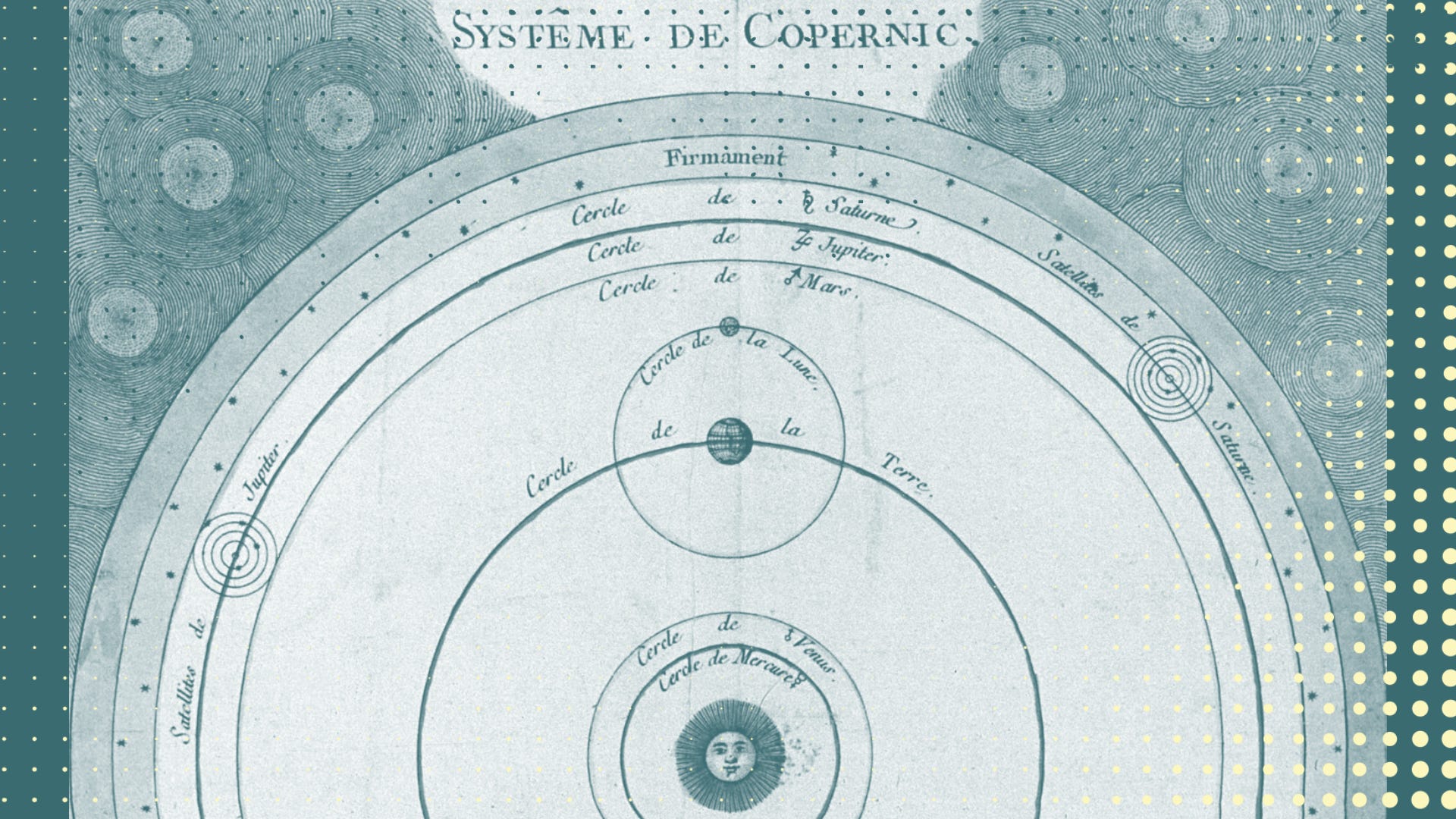
In the course of a recent conversation with Dwarkesh Patel, the distinguished mathematician Terence Tao proposed that we are living through “a cognitive version of the Copernican revolution,” in which humanity must come to terms with the fact that its intelligence is not the centre of the universe.1 The analogy is seductive, and it has been widely repeated by a few scientists. It deserves, I think, a more careful examination than it has so far received.
I believe this metaphor conceals a profound confusion about what intelligence is, what the human person is, and what is ultimately at stake when we speak of mind, meaning, and the place of the human person in this technological transformation.
This is not an essay against AI’s remarkable capabilities. It is an essay about what happens when there’s an unintended divorce between science and philosophy — a phenomenon with a long and instructive history. Curiously, though, the pattern has inverted since the last time it caused a cultural disaster.
The inversion: from bad philosophy stemming from misunderstood science to bad philosophy stemming from unlearned technologists.
A century ago, the problem ran in one direction. The great revolutions of early twentieth-century physics — quantum mechanics and relativity — were systematically misinterpreted by philosophers and public intellectuals who lacked the scientific training to understand what these theories said about reality. The uncertainty principle became “reality is unknowable.” Relativity became “everything is relative.” Profound, mathematically rigorous theories and new knowledge of natural phenomena were trivialised into metaphysical systems that parted ways from what the science had discovered.
At the time, the scientists themselves were learned enough to push back. Werner Heisenberg — the German physicist who won the Nobel Prize in 1932 for the creation of quantum mechanics — devoted much of his later career to untangling these philosophical knots. In Physics and Philosophy (1958), he tenaciously traced how positivists and half-informed commentators had distorted the meaning of quantum mechanics, and he did so from a position of genuine philosophical literacy.2 Heisenberg had read Plato, Aristotle, Descartes and Kant. He could engage with the philosophical tradition on its own terms, identify where it had gone wrong about physics, and offer corrections. He was not alone: Niels Bohr, Erwin Schrödinger, Albert Einstein and others brought serious humanistic education to bear on questions about what their discoveries meant for our understanding of reality.3
Today, the pattern has inverted, and the inversion is as much, if not more, dangerous because of the status the proponents of these dubious ideas have globally vs. the intellectuals of that era.
Now it is scientists, engineers, CEOs and technologists who are spreading bad philosophy. The Google engineer who declares that large language models may be sentient, the computer scientist who announces that human cognition is “just pattern matching,” the mathematician who casually asserts a Copernican revolution in intelligence, and the philosophers, not knowing the science, trust the scientists and develop logical conclusions like the singularity — the view that machines recursively improve themselves until they decide getting rid of humans is a more efficient world order. Popular figures from Silicon Valley are making far reaching philosophical claims while being, for the most part, embarrassingly ignorant of the philosophical traditions that have grappled with these questions for millennia.
Unlike Heisenberg, who could hold his own with Kant, the typical AI commentator making pronouncements about the nature of mind has not read — and often has not heard of — the thinkers whose work is most directly relevant.
Today, one would expect philosophers to correct scientists who get the philosophy wrong. But most contemporary philosophers, with notable exceptions, do not understand the technology well enough to engage credibly. The result is a vacuum, a space where bad philosophy circulates essentially unchallenged, because the people with the philosophical training lack the technical understanding, and the people with the technical understanding lack the philosophical training.
There are exceptions. Luciano Floridi — the Italian-British philosopher who holds the Castle Chair at Yale’s Digital Ethics Center, and whose work spans the philosophy of information, digital ethics, and AI — is one of the rare figures who combines genuine philosophical depth with serious technical understanding.4 His insight that AI represents “a divorce between agency and intelligence — the ability to solve problems successfully and the necessity of being intelligent in doing so” — is the kind of philosophically informed formulation that the discourse requires.5 But such voices are scarce. For the most part, we are living through a period in which the people making the loudest philosophical claims about AI are the least equipped to make them.
A word with a long and tortuous history
The difficulty begins with the word “intelligence” itself, which in contemporary usage has been so narrowed as to be almost unrecognisable to anyone formed in the great tradition of Western thought. The word has a history that most people deploying it in AI discourse seem merrily unaware of.
The Latin root, intelligere originally carried the sense of discernment: the ability to read between things, to perceive what is not immediately given.6
The ancient Greeks had an even richer vocabulary. Aristotle — the fourth-century BCE philosopher whose works on logic, metaphysics, ethics, and natural science shaped Western thought for two thousand years — used nous (νοῦς) for the highest faculty of the mind: the capacity for direct intellectual apprehension of first principles, the unprovable starting points from which all scientific demonstration proceeds.7
Note that it is not the realm of computing or calculus. It is not even what modern computation calls (stubbornly vomited everywhere these days) “pattern recognition.” It is something closer to insight — the grasp of what must be true before reasoning can even begin.
Plato — Aristotle’s teacher, and the founder of the Academy in Athens — had earlier distinguished nous from dianoia (discursive, step-by-step reasoning), placing intuitive intellect above the demonstrative kind in his famous analogy of the Divided Line.8
In the medieval period, the Latin intellectus became the scholarly rendering of nous, and it carried nontrivial metaphysical content. Thomas Aquinas — the thirteenth-century Dominican friar whose synthesis of Aristotelian philosophy and Christian theology remains foundational in Catholic thought — developed the concept of the intellectus agens (the active intellect), the faculty by which the mind abstracts universal forms from particular sensory experience.9 Let me say it again, this is not computing or inferring from repeated patterns; it is the movement from the concrete to the universal, from this triangle drawn in sand to the concept of triangularity itself.
The early modern period began belittling the word. Thinkers like Francis Bacon, Thomas Hobbes, and John Locke — the architects of British empiricism — abandoned the metaphysically onerous vocabulary of intellectus in favour of the more modest “understanding,” maybe deliberately so because they wanted to distance themselves from the elaborate scholastic apparatus of soul, intellect, and form.10
Then, in the early twentieth century, the psychometric tradition — Alfred Binet, Charles Spearman, David Wechsler — attempted to turn “intelligence” into something measurable: a score, a quotient, a position on a bell curve.11 As a brief aside, we should remember that Spearman and the American psychologists who adapted Binet’ s methods were deeply entangled with the eugenics movement, using their tests to rank human worth based on hereditary assumptions.12
What’s indisputable though, is that the rich philosophical concept of intelligence was operationalised into a number.
It is this final, hollowed-out, desiccated residue of the word that now exercises a quiet tyranny over our discourse concerning artificial intelligence. When the heralds of technology proclaim that these machines are “intelligent,” or summon us to “rethink intelligence” in the light of their silicon artifacts—while one cannot but ask, with a certain interior sorrow, why we do not rather rethink it in the light of that profound contemplative and eschatological tradition which our post-Enlightenment culture has so violently severed from itself—they wield in truth only a diminished, impoverished, and narrowed conception of intelligence: that melancholy reduction of a human mystery to measurable performance, to number, to a ranking upon tasks we have ourselves, and quite arbitrarily, declared to be the measures of cognitive worth.
And by that definition, yes, these models are strikingly capable, and on a number of tasks they surpass the average person. But read that sentence back, and notice how it sits with you. To me it has a patronising quality, and something faintly worse than that—does it not strike you the same way (what/who is the average person?)?
This is rather like concluding that a submarine swims. The submarine moves through water, it arrives at its destinations, it outperforms fish in a great many contexts. And yet something essential is lost the moment we file it under “swimming” and announce that our understanding of aquatic locomotion has been overturned.
I am not prepared to redefine intelligence merely so that we may go on lowering the bar. For we shall lower it, and lower it again, until at last nothing remains that is exceptional in being human. Is this truly what we desire?
The case against human exceptionalism
To be fair, the “Copernican” camp is not entirely wrong. There is a legitimate intention here, and it has some merit.
For centuries, human self-understanding has been warped by various forms of anthropocentrism. We assumed that our perceptual categories were the natural way to slice up reality, that our style of reasoning was the only kind, that the specific cognitive profile of Homo sapiens — good at narrative, mediocre at probability, brilliant at social inference, terrible at large-scale computation — was coextensive with “thinking” itself.
The psychometric tradition that José Hernández-Orallo, a Spanish computer scientist at the Universitat Politècnica de València whose work on universal psychometrics seeks to measure intelligence independently of any particular species or architecture, has critiqued the term was built entirely around human norms.13 Intelligence was what humans were good at, tested in ways that made sense for humans, scored against a distribution of other humans.
The advent of LLMs has shattered that narcissistic self-reflection, perhaps offering mankind an opportunity to rediscover the profound dimensions of intelligence that the reductive metrics have long obscured.
LLMs reveal that many tasks we intuitively coded as requiring “understanding” — summarisation, translation, analogy, even certain kinds of creative recombination — can be performed by systems that operate on entirely different principles than biological brains. Systems that, it is worth remembering, have been built by human inventiveness and skill and rely on a gargantuan amount of humanly generated artifacts (books, photos, videos, sounds, and so on).
Tao’s observation, while not universally applicable, that AI has “driven the cost of idea generation down to almost zero, in a very similar way to how the internet drove the cost of communication down to almost zero” may be applicable in some fields (I take he’s speaking of his experience in mathematics). What was once the bottleneck (generating possible approaches) is now cheap, faster, and the bottleneck has shifted to evaluation, judgement, and the ability to discern which ideas matter.14
Allow me one more digression. In domains like mathematics, idea generation might turn out to be a search problem, tractable to search over a well-structured, though gargantuan, possibility space. Mathematics, like the game of Go15 that AlphaGo16 so famously mastered by AI, is a self-contained world: its postulates are fixed, its rules logically defined, its moves exhaustively specifiable in principle. The space is finite, or at least formally bounded. Yet, it remains too vast for any single genius, or indeed any generation of mathematicians or players, to traverse in a lifetime. A breakthrough, in this kind of world, can be the discovery of something that was always there, waiting inside a space too large to search by hand. And there is another kind of breakthrough, and it is of an entirely different order: the invention of a new game altogether, a new mathematical system or physical theory, which preserves the old one as a special case while opening a wider range of possibilities—as general relativity did to Newton, as quantum mechanics did to classical physics. This second kind of breakthrough is not search. It is the construction of a new space within which new search problems becomes possible.
What the case against human exceptionalism tells us, in other words, concerns the structure of certain tasks: their decomposition, their information-theoretic properties, their susceptibility to search. And it tells us where the genuinely hard parts are shifting, where we could spend more time.
Hernández-Orallo’s “universal psychometrics” represents a serious attempt to develop measurement frameworks that are not biased toward any single cognitive architecture — what he calls measuring cognitive abilities “in the machine kingdom” (see footnote 12).
And the broader point about cognitive diversity is well taken.
We have always lived among other intelligences — the navigational genius of migratory birds, the distributed cognition of ant colonies, the chemical computation of plant root networks. Recognising that intelligence comes in many forms, with radically different profiles of strength and weakness, is not a demotion of humanity. Rather, it is an enrichment of our understanding of nature.
The case for human exceptionalism (the right kind)
There is a slide — subtle, often unconscious — from the reasonable claim that human intelligence is not the only kind of information processing in the universe to the much stronger claim that humans are not exceptional in any deep or important sense, especially in the post-Enlightenment age where reason and intelligence have been wielded as the most important dimensions of humanity. This second claim is not an empirical discovery but a poorly supported philosophical stance — and, I would add, a misanthropic one.
Start with the most basic observation: humans are the only entities in the known universe that ask the question.
The fact that this debate is happening at all — that Tao and other illustrious scientists can formulate the Copernican analogy, that Emily Bender and her colleagues can mount the “stochastic parrot” critique,17 that researchers across disciplines can argue about the nature of mind — is itself a datum that the deflationary view cannot easily accommodate. LLMs participate in conversations about intelligence. For instance, I “chatted” with several LLMs to clarify and polish this article. They do not, so far as anyone can tell, care about the answer. My friend Simón Villegas Restrepo, who helped me (more successfully than the LLMs) develop ideas for this article, cares.
Immanuel Kant — the eighteenth-century German philosopher whose three Critiques remain among the most influential works in modern philosophy — grounded human dignity in rational autonomy: the capacity to set one’s own ends, to act according to self-legislated moral principles, to treat other persons as ends in themselves rather than merely as means. “Rational nature exists as end in itself,” he argued in the Groundwork of the Metaphysics of Morals (1785).18 You can quibble with Kant’s framework (many have), but the core insight has proven remarkably durable: there is something about the human capacity for moral self-determination that is categorically different from the ability to optimise an objective function.
An LLM can generate a (sometimes) compelling consequentialist argument for any position you like. What it cannot do — and here the stochastic parrot critique, for all its crudeness, points at something real — is mean it. It cannot stake its existence on a moral commitment. It cannot, in the sense of Søren Kierkegaard — the nineteenth-century Danish philosopher who insisted that truth must be personally appropriated through existential commitment — make a leap.19
Hannah Arendt — the twentieth-century German-American political theorist, a student of Martin Heidegger and Karl Jaspers, whose work on totalitarianism and the nature of political action reshaped modern thought — drew a distinction that goes one level deeper. In The Human Condition (1958), she argued that what is most distinctively human is not labour (which we share with animals) or work (which produces the durable objects of civilisation), but action — the capacity to begin something genuinely new, to insert oneself into the world as a unique and unrepeatable being. “In acting and speaking,” she wrote, “men show who they are, reveal actively their unique personal identities and thus make their appearance in the human world.”20 This disclosure of who someone is, as opposed to what they are — their qualities, talents, and shortcomings — is, for Arendt, the domain of freedom, of plurality, of the political. It is what makes each person not a token of a type, but a source of irreducible novelty.
An LLM generates novel text. It does not act in Arendt’s sense. It does not disclose a who. It does not carry the weight of a life, a history, a set of commitments and betrayals and loves that make a particular utterance this person’s utterance and no one else’s. Which also illuminates the debacle among many writers and scholars about writing with or without LLMs. I extensively use LLMs to help me write, but it is entirely my thought, my action, my research, my history that influenced the desire to put down these words and share them. I sympathise with scholars who lament attribution — but let’s keep that debate for another time.
The confusion between generating novel outputs and performing genuinely new action is one more philosophical mess of the current moment.
The Enlightenment’s amusing detour
There is a deeper irony that is worth savouring. The intellectual tradition that is now most enthusiastic about dethroning human intelligence is, in a sense, the same tradition that enthroned it in the first place.
The Enlightenment project was a sustained effort to place human reason at the summit of the knowable universe. Out went revelation, tradition, and divine authority; in came empiricism, rationalism, and the sovereignty of the thinking subject. Kant adopted the ancient Roman poet Horace’s injunction — Sapere aude, “Have courage to use your own understanding!” — as the motto of the Enlightenment, a declaration that human reason needed no external warrant.21 It was its own foundation.
Kant himself described his philosophy as a “Copernican revolution.” In the Critique of Pure Reason (1781), he reversed the traditional view that knowledge conforms to objects, claiming instead that objects must conform to the conditions of our knowledge.22 The AI enthusiasts now heralding a “cognitive Copernican revolution” are arriving comically late to a party that Kant threw in the eighteenth century. In fact, they are reversing the revolution again: Kant put reason at the centre; they seek to dethrone it. If the Copernicus analogy is apt, it is like repeatedly moving the Sun in and out of the solar system according to the most viral swing on social media.
The comparison is instructive in another way. Copernicus’s original shift of perspective was brilliant because it solved real problems in natural sciences: the epicycles and equants that had accumulated in Ptolemy’s system were symptoms of a model that had placed the wrong thing at the centre, and the heliocentric reframing dissolved them.
Kant’s “Copernican” turn, at least, attempted to solve a genuine philosophical problem — how synthetic a priori knowledge is possible — by relocating the structuring conditions of experience from the object to the subject.
A reasonable question emerges: what exactly are the problems that the new “cognitive Copernican revolution” is solving? If it is, as this essay has argued, merely the latest chapter of a positivism operating with an impoverished sense of intelligence, then the answer is: none. It is rediscovering a pre-modern insight while having systematically discarded the conceptual tools that once made that insight philosophically productive. Kant’s noumenon — the thing-in-itself that lies beyond the reach of empirical knowledge — is itself a reminder that there are limits to what the knowing subject can grasp, a kind of “negative knowledge” that marks the boundary of cognition. The current discourse could use a similar dose of epistemic humility.
By rooting all authority in human rationality, the Enlightenment placed the entire burden of meaning and truth on human reason. When Friedrich Nietzsche — the nineteenth-century German philosopher whose diagnosis of European nihilism proved prophetic — declared that God was dead,23 he understood something crucial. Far from a celebration, his pronouncement warned that if human reason is the only source of meaning and value, then the entire edifice of civilisation rests on something far more fragile than its architects supposed. In today’s ironic twist, AI is exposing this fragility in plain sight.
Now, the heirs of the Enlightenment are busily dismantling the very pedestal they built. Having spent three centuries insisting that human reason is the measure of all things, the technologist of the AI age announces that, actually, human reason is not so special after all. There are other intelligences. We are not the centre. Some are even rebuilding the concept of god by saying we created “godlike” technology. Some, I’d dare to say, would even go as far as thinking AI is a kind of new god.
Various traditions, of course, have maintained this all along, under different names and frameworks — and not only theistic ones.
South American indigenous cultures, for instance, have long understood ayahuasca, trees, and jaguars as bearers of wisdom and intelligence; they could think of ecosystems themselves as intelligent instances. “The jungle knows,” as the saying goes. “The river knows.”
This “new” cognitive Copernican revolution is, from certain angles, secular thought rediscovering what it spent centuries denying — but arriving at the destination stripped of the conceptual resources (dignity, personhood, teleology) that once made the co-existence of human and non-human intelligence philosophically manageable. This is what makes the current discourse not just mistaken but shallow. Floridi’s observation that AI represents a divorce between agency and intelligence is so valuable because it resists that dilettantism. The divorce gives us a conceptual tool for understanding what is genuinely new about AI without banalising into either hysteria or deflation (see footnote 5).
The value of dignity
The worst forms of human exceptionalism are well known and rightly condemned. The idea that one group of humans is inherently superior to another — the ideological foundation of every genocide — is exceptionalism at its most catastrophic. When people are rightly wary of “human exceptionalism,” this is often what they have in mind (I hope): a ranked ordering of beings, with a particular subset of humanity conveniently at the top.
But there is another exceptionalism — call it dignitarian exceptionalism — that has nothing to do with ranking and everything to do with recognising a specific kind of value. And, if you hate hierarchies, let’s say a different place for humans in nature: have you ever asked why humans care about other animal species so much so that they feel responsible for their wellbeing and survival? Have you seen any cows caring for pandas? Or ants organising NGOs to protect white bears? Humans care and defined (or discovered?) the concept of dignity.
A person with severe intellectual disabilities has the same dignity as a Nobel laureate. A newborn infant, who cannot pass any cognitive benchmark, is no less a person than the most brilliant mathematician. This should be obvious, but in a culture that increasingly measures worth by performance and productivity, it needs to be said with renewed force. Human dignity does not rest on being the best reasoner in the room. If the argument is “LLMs can do X, therefore humans are not exceptional,” then we have implicitly accepted that exceptionality depends on doing X. That’s Batman morality: “It’s what you doooo, that defines youuu [rough voice].
Human dignity does not rest on being the best reasoner in the room. Rather, on the capacity for love, for moral commitment, for self-awareness, for the peculiar and unquantifiable experience of being a someone rather than a something.
Both poles of the reaction are true, but in different registers. “Relax, you’re not that important” is true in the cosmic sense: we are not the centre of the universe, our cognitive style is one among many, our pattern-matching has measurable limits. But “don’t worry, you are indeed exceptional and unique and infinitely valuable” is equally true, in the register of ethics, of dignity, of what it means to stand before another person and recognise them as an end in themselves.
The philosophical task is to hold both of these truths at once. The deflationary view (“we’re just another form of information processing”) and the inflationary view (“humans are the crown of nature”) are each wrong in isolation and each captures something real. The hard work — the genuinely philosophical work, not the Davos-panel or podcast version — is to articulate a framework in which cognitive humility and personal dignity coexist without contradiction.
The true Copernican lesson
It is worth remembering what the actual Copernican revolution taught us. Copernicus did not prove that the Earth was unimportant. He proved that it was not the centre of the universe. These are different claims.
The cultural resistance to heliocentrism was not really about orbital mechanics. It was about what the geometry was taken to mean. In a world where philosophy and theology had not yet learned to treat science as one method of knowledge among others — rather than as a rival account of ultimate reality — to demote the Earth spatially felt like demoting it in every other sense. If the Earth was no longer at the centre of creation, then creation itself seemed to lose its centre of gravity. The fear was that the novel discovery would hollow out the significance of human life.
That fear was misplaced, and we can see now why. The Earth after Copernicus was no less remarkable — no less the home of life, consciousness, culture, love, and suffering — for not being at the geometrical centre of the solar system. The same confusion persists today among those who assume that because science describes the physical structure of reality with remarkable success, it must therefore exhaust what is real, leaving no room for meaning, value, or anything that does not appear on an instrument. This is the Ptolemaic anxiety of the secularist dogma: the worry that to locate ourselves honestly within nature is to lose whatever made us worth locating in the first place.
If anything, the recognition of our true position in the cosmos made the existence of these things more astonishing, not less. The universe is vast and largely indifferent, and yet here we are: beings who compose symphonies and mourn their dead and argue about the nature of intelligence.
If AI teaches us that human cognition is one island in a larger archipelago of possible information-processing systems, this is a valuable lesson. At the same time, that risks being a move from “we are not the only intelligence” to “we are not importantly different”. Every time a civilisation has convinced itself that certain categories of beings lack significance, the results have been dreadful. The direction of true progress ought to be toward expanding the circle of dignity, not contracting it.
The stochastic parrot critique and the Copernican intelligence thesis are, in a sense, mirror-image errors. One says: machines can’t really think, so nothing has changed. The other says: machines can really think, so everything has changed. Both are wrong because both assume that “thinking” can be a well-defined, in the scientific sense, dimension, and that the philosophical question is simply whether machines do or do not possess it. By the way, both forget that we (unexceptional humans) figured out how to make machines “think” or “parrot” convincingly.
The richer question — the one that Hernández-Orallo’s universal psychometrics begins to gesture at, and that Tao’s mathematical experience illustrates vividly — is how to map the full space of cognitive possibilities without reducing the ethical and existential dimensions of being a particular kind of mind. An LLM occupies a fascinating region of that space, if there is such a thing. So does an octopus. So does a person reasoning about what to do in a moral emergency. These are not points on a single scale. They are different kinds of things, and the philosophical vocabulary we need is one that can honour that difference without either inflating human cognition into the measure of all things or deflating human personhood into just another data point. For now, Floridi’s insistence on “agency” remains the most useful conceptual framework.
Martin Heidegger — the twentieth-century German philosopher whose later work on the essence of technology remains among the most penetrating analyses of modernity — observed that technology itself cannot think about the essence of technology.24 The same applies, with even greater force, to intelligence: if intelligence is reduced to computing, to what Heidegger called rechnendes Denken (calculative thinking), then it cannot grasp its own nature. Henri Bergson — the early twentieth-century French philosopher whose work on consciousness, time, and evolution earned him the Nobel Prize in Literature — put it with characteristic precision: one must think against intelligence to understand the genesis of intelligence.25 This is the recognition that intelligence, in its deepest sense, exceeds the scope of any particular exercise of it — including the exercise of building machines that simulate it.
—
The scientists and technologists now rushing to announce a Copernican revolution in intelligence are, in many cases, making the same kind of mistake that philosophers and public intellectuals made with quantum mechanics a century ago — extracting sweeping metaphysical conclusions from genuine empirical discoveries, without doing the careful conceptual work required to know what those discoveries actually are, and then, only then, what they mean. The difference is that back then, learned scientists could set the record straight. Today, there is a vacuum where the corrective should be. As our chief scientist at Gradient Institute — a non-profit research organisation helping policymakers and industry leaders to have clarity on AI based on science — science is about what things do, metaphysics is about what things are. (We plan to write a blog about this, and what it means for the science of artificial intelligence — stay tuned!)
That work is harder and slower than writing a viral tweet (hence this very long article, sorry!). It requires engaging seriously with the philosophical tradition — with Aristotle on nous, with Aquinas on dignity, with Arendt on action, with Heidegger on the essence of technology, with Bergson on the limits of the intellect, with Floridi on the philosophy of information, with the full, tangled history of what we have meant and failed to mean by “mind” and “intelligence” and “person.” It requires, above all, the intellectual humility to recognise that being good at building intelligent systems does not make you an authority on what intelligence is — any more than being good at building telescopes makes you an authority on what the stars are for.
References
Arendt, H. (1958). The human condition. University of Chicago Press.
Aristotle. (c. 340 BCE/2009). The Nicomachean ethics (D. Ross, Trans.; L. Brown, Rev.). Oxford University Press.
Bender, E. M., Gebru, T., McMillan-Major, A., & Shmitchell, S. [Mitchell, M.] (2021). On the dangers of stochastic parrots: Can language models be too big? In Proceedings of the 2021 ACM Conference on Fairness, Accountability, and Transparency (pp. 610–623). https://doi.org/10.1145/3442188.3445922
Burchard, P. (2025). The AI pipeline fallacy [LinkedIn post]. https://www.linkedin.com/posts/paulburchard_artificialintelligence-machinelearning-activity-7199091650701246464-lb0y
Floridi, L. (2014). The fourth revolution: How the infosphere is reshaping human reality. Oxford University Press.
Floridi, L. (2019). What the near future of artificial intelligence could be. Philosophy & Technology, 32(1), 1–15. https://doi.org/10.1007/s13347-019-00345-y
Floridi, L. (2023). The ethics of artificial intelligence: Principles, challenges, and opportunities. Oxford University Press.
Heisenberg, W. (1958). Physics and philosophy: The revolution in modern science. Harper & Brothers.
Hernández-Orallo, J. (2014). Universal psychometrics: Measuring cognitive abilities in the machine kingdom. Cognitive Systems Research, 27, 50–74. https://doi.org/10.1016/j.cogsys.2013.06.001
Hernández-Orallo, J. (2017). The measure of all minds: Evaluating natural and artificial intelligence. Cambridge University Press.
Holden LR, Tanenbaum GJ (2023). Modern Assessments of Intelligence Must Be Fair and Equitable. J Intell, (6):126. 10.3390/jintelligence11060126
Kant, I. (1784/1996). An answer to the question: What is Enlightenment? In M. J. Gregor (Ed. & Trans.), Practical philosophy (pp. 11–22). Cambridge University Press.
Kant, I. (1785/2012). Groundwork of the metaphysics of morals (M. Gregor & J. Timmermann, Trans.; Rev. ed.). Cambridge University Press.
Kierkegaard, S. (1843/1983). Fear and trembling (H. V. Hong & E. H. Hong, Trans.). Princeton University Press.
Nietzsche, F. (1882/2001). The gay science (J. Nauckhoff, Trans.; B. Williams, Ed.). Cambridge University Press.
Plato. (c. 380 BCE/2006). Republic (R. E. Allen, Trans.). Yale University Press.
Tao, T. (2026, March 20). Kepler, Newton, and the true nature of mathematical discovery [Interview by D. Patel]. Dwarkesh Podcast. https://www.dwarkesh.com/p/terence-tao
Bergson, H. (1907/1911). Creative evolution (A. Mitchell, Trans.). Henry Holt and Company.
Heidegger, M. (1954/1977). The question concerning technology. In The question concerning technology and other essays (W. Lovitt, Trans.; pp. 3–35). Harper & Row.
Heidegger, M. (1959/1966). Discourse on thinking (J. M. Anderson & E. H. Freund, Trans.). Harper & Row.
Kant, I. (1781/1998). Critique of pure reason (P. Guyer & A. W. Wood, Trans.). Cambridge University Press.
Viveiros de Castro, E. (1998). Cosmological deixis and Amerindian perspectivism. Journal of the Royal Anthropological Institute, 4(3), 469–488. https://doi.org/10.2307/3034157
Viveiros de Castro, E. (2014). Cannibal metaphysics: For a post-structural anthropology (P. Skafish, Trans.). Univocal Publishing.
Notes
Tao, in Patel (2026). The full quote: “Right now we’re going through a cognitive version of the Copernican revolution, where we used to think that human intelligence is the centre of the universe, and now we’re seeing that there are very different types of intelligence out there with very different strengths and weaknesses.”
Heisenberg (1958). Heisenberg argues throughout the book that the positivistic reading of quantum mechanics — that it proves reality is subjective or unknowable — misunderstands the theory’s actual philosophical implications. He writes: “The positivists have a simple solution: the world must be divided into that which we can say clearly and the rest, which we had better pass over in silence. But can any one conceive of a more pointless philosophy, seeing that what we can say clearly amounts to next to nothing?”
Schrödinger, for instance, devoted What Is Life? (1944) and Mind and Matter (1958) to the philosophical implications of physics and biology. Bohr’s concept of complementarity drew explicitly on philosophical traditions.
Floridi holds the John K. Castle Professor in the Practice of Cognitive Science chair and is the founding director of the Digital Ethics Centre at Yale University. He was previously the OII Professor of Philosophy and Ethics of Information at the University of Oxford. See Floridi (2014) for his account of the “fourth revolution” in human self-understanding.
Floridi (2019, p. 1). The full formulation: AI should be understood “not as a marriage between some biological-like intelligence and engineered artefacts, but as a divorce between agency and intelligence, that is, the ability to solve problems successfully and the necessity of being intelligent in doing so.” See also Floridi (2023) for the fuller development of this thesis.
The Latin intelligere is a compound of inter (between) and legere (to choose, pick out, read), giving the literal sense of “to discern” or “to read between.” See the Oxford Latin Dictionary entry for intellego.
Aristotle, Nicomachean Ethics, Book VI, Chapter 6. Aristotle writes that “it is intuitive reason [nous] that grasps the first principles” — the limiting premises for which no further demonstration can be given. See Aristotle (c. 340 BCE/2009, 1141a7).
Plato, Republic, 509d–511e. In the analogy of the Divided Line, Plato ranks four states of the mind: eikasia (imagination), pistis (belief), dianoia (discursive thought), and nous (direct intellection), with nous as the highest. See Plato (c. 380 BCE/2006).
Thomas Aquinas, Summa Theologiae, I, q. 79, aa. 3–4. Aquinas develops Aristotle’s De Anima III.5 into a systematic account of how the intellectus agens (active intellect) abstracts intelligible forms from sensory phantasms.
Locke’s Essay Concerning Human Understanding (1689-90) is the landmark text here; the very title signals the shift from intellectus to “understanding.” Bacon, Hobbes, and Locke all deliberately adopted more empirically modest vocabulary.
Binet and Simon developed the first practical intelligence test in 1905; Spearman proposed the general factor g in 1904; Wechsler published the Wechsler-Bellevue Intelligence Scale in 1939. For an overview, see Hernández-Orallo (2017, Chapter 2).
“Based on the problematic views of eugenics, intelligence testing was used in harmful and unjust ways. The Stanford–Binet test was used to separate students with learning disabilities and later as justification for forced sterilization of people with learning disabilities and racial minorities by the U.S. Supreme Court. This occurred even though its creator, Alfred Binet, was one of the few intelligence scientists who rejected eugenics.” See Holden LR, Tanenbaum GJ (2023).
Hernández-Orallo (2014; 2017). His programme aims to develop evaluation tools that can measure cognitive abilities across biological and artificial systems using a common, architecture-independent framework.
Tao, in Patel (2026). Tao’s full formulation: “I think AI has driven the cost of idea generation down to almost zero, in a very similar way to how the internet drove the cost of communication down to almost zero.”
Go is an ancient board game of Chinese origin in which two players place stones on a grid to surround territory. Despite having simple rules, its possibility space is astronomically large—vastly larger than chess—which long made it resistant to computational approaches.
AlphaGo, developed by DeepMind, was the first AI system to defeat a world-top professional Go player, Lee Sedol, in 2016. Its victory was considered a landmark in AI because it relied not on brute-force enumeration but on a combination of deep neural networks and search, finding strong moves in a space too large to compute exhaustively. It is worth noting, however, that this apparent mastery has limits. Paul Burchard, founder of Artificial Genius and former Head of R&D and Managing Director at Goldman Sachs, has pointed out that despite claims of “superhuman” AIs trained on unlimited self-play datasets, researchers have found that by playing unconventional moves that would never have appeared even in enormous training datasets, they can reduce these AIs to a sub-amateur level, causing fatal mistakes that no human player would make. The brittleness, Burchard argues, is a symptom of a deeper problem: the “AI pipeline fallacy” — the assumption that intelligence can be reduced to collecting data, training a model, and running inference. “Actual intelligence,” he observes, “doesn’t work anything like this.” See Burchard (2023).
Bender et al. (2021). The paper defines a “stochastic parrot” as a system that “stitching together sequences of linguistic forms… observed in its vast training data, according to probabilistic information about how they combine, but without any reference to meaning.”
Kant (1785/2012, 4:429). The second formulation of the categorical imperative: “So act that you use humanity, in your own person as well as in the person of any other, always at the same time as an end, never merely as a means.”
Kierkegaard’s Fear and Trembling (1843) explores the “leap of faith” as an existential commitment that cannot be reduced to rational calculation. The concept was developed further in Concluding Unscientific Postscript (1846).
Arendt (1958, p. 179). The full passage: “In acting and speaking, men show who they are, reveal actively their unique personal identities and thus make their appearance in the human world, while their physical identities appear without any activity of their own in the unique shape of the body and sound of the voice. This disclosure of ‘who’ in contradistinction to ‘what’ somebody is… is implicit in everything somebody says and does.”
Kant (1784/1996). The original essay, “Beantwortung der Frage: Was ist Aufklärung?”, was published in the Berlinische Monatsschrift in December 1784. The phrase Sapere aude originates from Horace, Epistles, I.2.40 (20 BCE).
Kant (1781/1998, Bxvi). The full passage: “Up to now it has been assumed that all our cognition must conform to the objects; but… let us once try whether we do not get farther with the problems of metaphysics by assuming that the objects must conform to our cognition.” Kant explicitly compares this reversal to Copernicus’s hypothesis.
Nietzsche (1882/2001, §125). The famous proclamation appears in The Gay Science: “God is dead. God remains dead. And we have killed him.” Nietzsche understood this not as a triumph but as a civilisational crisis.
Heidegger (1959/1966, pp. 46–47). Heidegger distinguishes “calculative thinking,” which “computes… counts on definite results,” from “meditative thinking,” which “contemplates the meaning which reigns in everything that is.” His warning: “Man today is in flight from thinking… But part of this flight is that man will neither see nor admit it.”
The formulation "think against intelligence" (penser contre l'intelligence) captures Bergson's methodological programme in Creative Evolution: that intuition — a mode of sympathetic, durational awareness — must supplement and sometimes oppose the intellect's tendency toward static, spatial categories. See Bergson (1907/1911, Chapter 2)
Thank you for writing this. It put its finger on something that has made me increasingly uneasy, the argument that intelligence is a set of capabilities. It reduces humans to a list of things they can do and can be measured.
You’re hitting most of the right pints sir. Bravo.