

The role of the educator in the age of AI

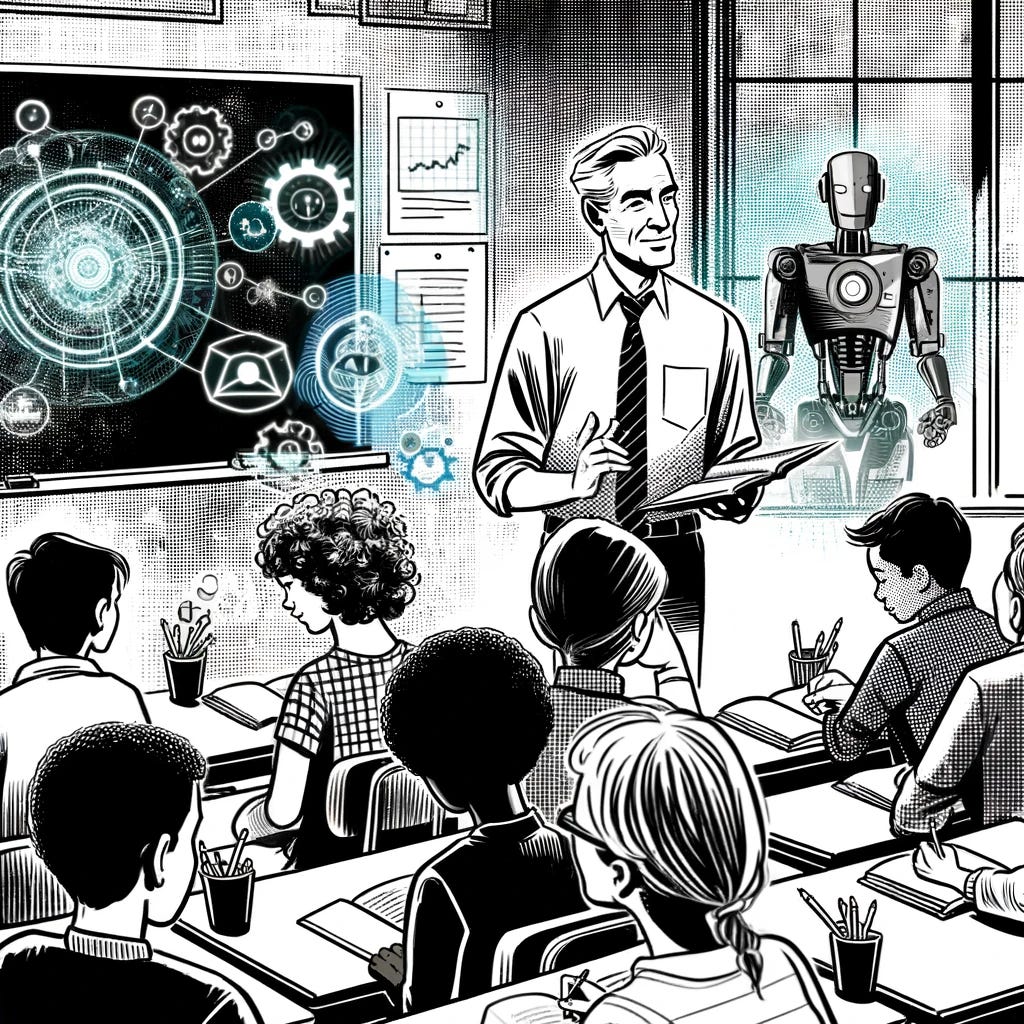
In the third part of this AI and storytelling mini-series, I reflect on the teachings of Fr Luigi Guissani, an Italian Catholic priest, theologian, and educator, and research by Jonathan Haidt, as they both relate to education.
In parts one and two, I explored AI and storytelling in our education system – touching on everything from the legacy of one of my favourite teachers, Mr. Mangolini, and the impact a good teacher can have on one’s lifetime, as well as a recent workshop that I ran with teachers in the Vicariate of Southern Arabia. This workshop emphasized the importance of augmenting teaching with AI, and this idea that “Teaching is a work of affection”.
Today, I want to explore the research of Jonathan Haidt, an American social psychologist and author, who published an excellent article on ‘The Coddling of the American Mind’ on The Atlantic. If you haven’t read it, I implore you to do so. That, and a recent tweet of his, signposts that we are in troubling times when it comes to how we, as a society, are teaching our children.
Of course, Haidt’s research focuses on American universities and colleges, but I’d argue that this trend can be seen globally.
How today’s schools have changed since millennial classrooms
As a millennial, a contemporary of Mark Zuckerberg, Sam Altman, and Mustafa Suleyman, I grew up in a world where technology was just beginning to spark ideas. Smartphones were yet to be omnipresent in classrooms.
Is it right to say that we, the architects of today’s AI-driven tech landscape, were able to create this generation of founders thanks to not having the constant distraction of iPads and smart devices?
When we ask the question, “What is education?” we often refer to the dictionary definition: a systematic process of receiving or giving instruction, particularly in a school or university experience.
However, the etymology of ‘education’, stemming from the Latin ‘educatio’ and ‘educare’ (meaning ‘to lead out’), reveals a more profound, deeper interpretation. It suggests that true education is about leading a child’s development from within themselves, drawing out their inherent capabilities, and fostering their natural curiosity.
It suggests that true education is about leading a child’s development from within themselves, drawing out their inherent capabilities and fostering their natural curiosity.
Italian educator Fr. Luigi Giussani takes this definition a step further. He saw education as the process of helping the human spirit come into contact with the entirety of reality, understanding the elements that constitute it. It’s about communicating the past (a tradition), living in the present, and inspiring students to engage actively with the world around them. This interpretation has assonances with the oriental spiritualities centered around mindfulness, as well as the idea that education isn’t just about imparting skills or behaviors. It’s about nurturing the whole person.
So, where does AI and technology fit into this landscape?
The capabilities of AI are astounding, with its ability to process information, stimulate empathy, and even mimic human interactions. However, can these mechanical entities, as advanced as they may be, truly replace the nuanced and deeply human task of education? The process of drawing out a child’s nature to understand and live in our earth’s reality cannot be fully replicated by a programmed machine; but then again, does that not make our machine not fully real?
That brings us to a wider question, which many religions are actively exploring – in the age of virtual reality (VR) and AI, what is reality? How does AI, and the creation of the metaverse, change our perception of what is real and what is not? Do experiences and memories created in the ‘metaverse’ count as real, lived experiences, or are they separate to the human lived experience?
I return to the point that I landed on in the previous post, and argue that while AI can be used in smart ways to enhance the educational experiences, I do not believe it can or should replace the human experience of teaching. After all, we are already seeing the effects of ‘a coddled American mind’.
Do we really want to see this get even worse, or watch as our future generations get further detached from reality? The role of a teacher extends so far beyond the exchange of knowledge; it involves being a mentor, a guide, and a role model. All of these roles are human by nature.
Summary
In summary, as we continue to explore the role of AI and storytelling in education, it’s crucial to remember that the task of education is not just to inform but to transform, and this transformation happens through empathy, intuitive connections, and deep affection.
Let’s use technology as a means to aid education by all means, but let’s never forget the irreplaceable value of human teachers in shaping future generations.
Further reading
Rynio, A. Fr Luigi Giussani’s Concept of Education - An Outline https://czasopisma.upjp2.edu.pl/thepersonandthechallenges/article/view/858/751.
Lukianoff, G. and Haidt, J. "The Coddling of the American Mind." The Atlantic, September 2015. https://www.theatlantic.com/magazine/archive/2015/09/the-coddling-of-the-american-mind/399356/.