
The Grunt Work That Built Genius

Hi dear readers and friends,
Welcome to the Human Override. Twice a month, I share short reflections about AI and society, ending with the “Human Override” (a way to preserve humanity when everything turns synthetic).
New readers highlight: Peter M, CMO | Helen M, SVP Consumer Products | Justin M, Chief Customer Officer | Bianca I, Founder | Shelly N, MIT Sloan MBA | Shally, Amy, Colin and +296 more legends! Welcome!
STORY
When Fei-Fei Li spent years hand-curating ImageNet—millions of images, labelled one by one—there was no AI to help. The work was tedious, often maddening. But something else was happening in that tedium. She was building intuitions that no shortcut could provide.
Three weeks ago, Li launched Marble: a world model that generates interactive 3D environments from text or images. Entire navigable spatial worlds, pretty cool, huh?!
ImageNet enabled the breakthroughs in deep learning, the AI architectures behind all of today’s marvellous technology, which came from years of struggle. Now we’re building tools that eliminate struggle entirely. What are we trading away?
Consider one developer’s confession. ”I’ve become a human clipboard,” he wrote. Top engineer, 14 years at Google, the kind who once relished hunting down gnarly bugs. Now errors flash, he copy-pastes into ChatGPT, receives the solution, pastes it back. Problem solved. Nothing learned.
A Microsoft and Carnegie Mellon study confirmed the pattern: the more people lean on AI, the less critical thinking they engage in. Some research or article I read long ago (sorry, I couldn’t find the source) used the term “learned technological helplessness.” The phrase stings because it describes a choice, while many internalise it as fate. We learn to be helpless.
Meanwhile, the infrastructure shifts quietly, outside the spotlight (still obsessively pointing to generative AI). China’s Darwin Monkey 3, a neuromorphic chip mimicking brain processing, outperforms traditional supercomputers at the edge. Intel’s Hala Point runs 1,152 neuromorphic processors. MIT’s photonic chips perform neural computations using light, completing tasks in under half a nanosecond. Humanoid robots are moving from lab trials to commercial deployment.
So, are we doomed to become human clipboards, or can we actually do more interesting things when machines can do what we once did?
THE HUMAN OVERRIDE
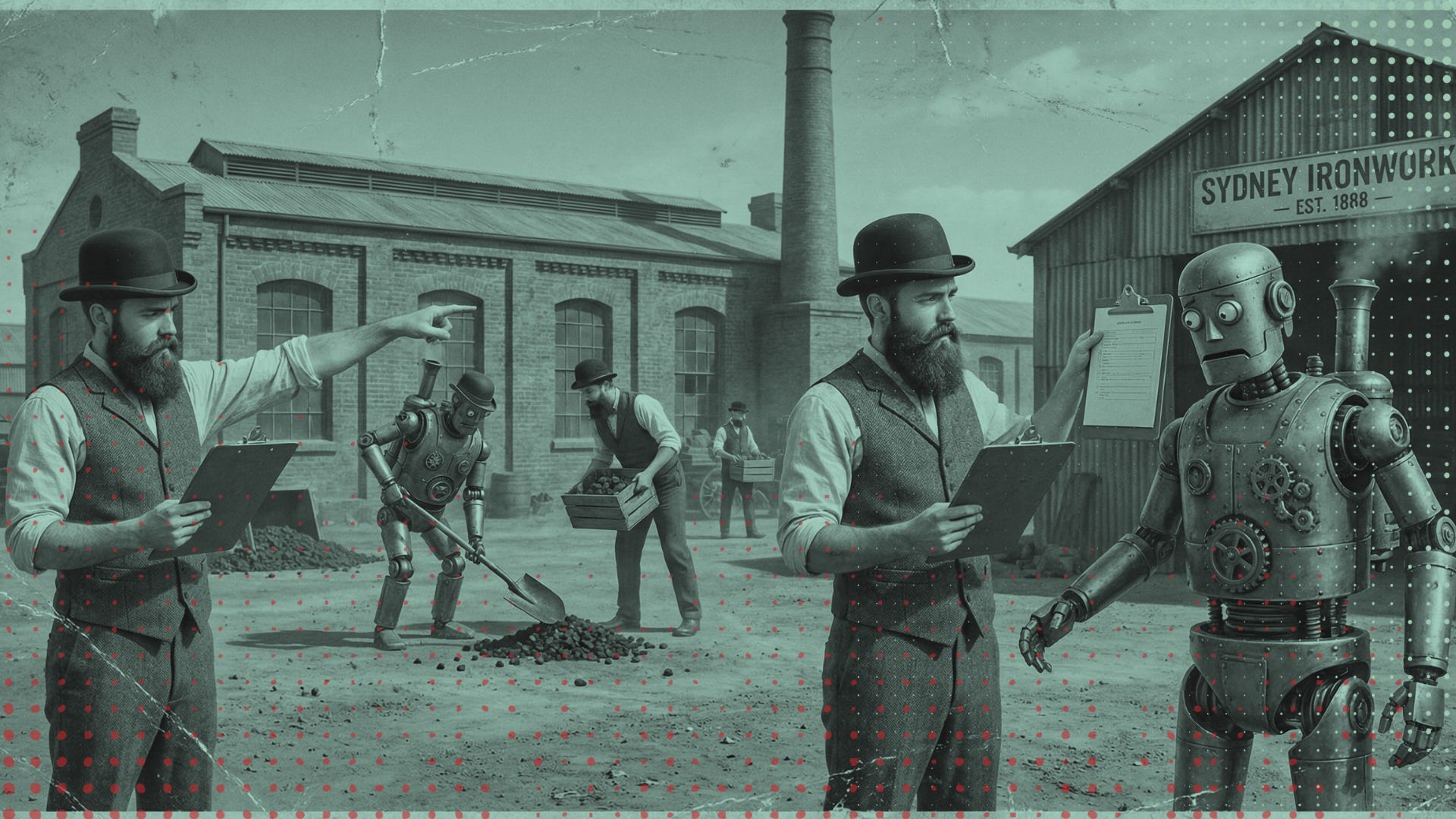
“Become an AI supervisor” sounds reasonable. In practice, it often means watching outputs, clicking approve, slowly losing the skills that made you valuable… while all becomes boring as hell!
There’s a better path.
Cognitive expansion
Take these two organisations: they use the same tools but achieve different, equally interesting outcomes.
Morgan Stanley’s financial advisors did not mandate leveraging AI copilots to handle triple the clients, but they focused on reclaiming time for complex strategy sessions that paperwork once made impossible. NVIDIA’s robotics team offloads simulation grunt work to AI, then channels freed hours into exploring robot behaviours no one has imagined.
Both ways expand the surface: they leverage AI gains to expand cognitive capacity. One approach creates human clipboards. The other creates human persons who are more capable than before.
What you can start today
1. The 90-day hands-on project
Pick one emerging area. Build something real within 90 days. If you’re in traditional tech, learn PyTorch (neuromorphic companies use it). If you’re in healthcare or manufacturing, map how AI integrates into your domain. Start before you feel qualified.
2. Protect your foundation
Set aside time weekly for manual work. One developer practices “AI-free Fridays”—no copilot, no ChatGPT. His debugging instincts stay sharp. Your foundational skills let you recognise when AI gets it wrong. Without them, discernment disappears.
I used to think foundation maintenance was inefficient, a waste of time. I’d better spend time on new capabilities. Wrong! The foundation is what makes new capabilities trustworthy.
3. Build hybrid intelligence roles
At law firms, valuable people know exactly when AI’s “good enough” will get a client sued. While Deloitte hasn’t learned it yet (perhaps they should have accepted my application to return to work with them two years ago… well, too late, mate!). The skill is transitioning from operating the tool to knowing its limits. Give Gradient Institute a buzz to train your team to discern AI capabilities and calibrate their trust in AI.
No PhD required. Lawyer + AI ethics = emerging role. Marketer + AI strategy = $95K-135K positions. Banker who knows when not to trust models becomes irreplaceable.
4. Cross-pollinate
Neuromorphic computing creates jobs that didn’t exist five years ago: chip designers who understand neuroscience, developers building spiking neural networks, and integration specialists deploying brain-inspired systems in robotics. Another cool trend I learned recently is that electricians, air conditioning, and other cooling systems are becoming important industries to support the gargantuan data centre build-up. There are tonnes of innovations still waiting to happen here, and there’s already a shortage of these skills.
5. Document Publicly
Blog, post, create videos. Companies hiring for emerging roles reward visible curiosity over polished credentials. Your learning journey is evidence you can adapt.
You’re on your own
Only 35% of US companies offer frequent role-specific training. Most organisations won’t build pathways for you. Waiting for permission is a losing strategy.
The companies getting this right deliberately restructure work so the human contribution becomes more intellectually demanding. If yours isn’t thinking this way, push, or find one that is.
SPARK
If an entire generation never knows the satisfaction of solving problems unaided, never experiences the hard-won understanding that comes from struggling, what becomes of breakthrough thinking?
Fei-Fei Li’s grunt work was the teacher. The tedium built into intuitions no shortcut could provide. What happens when we optimise away tedium entirely?
Maybe we evolve different cognitive muscles. Maybe the next generation finds forms of mastery we can’t imagine. Or maybe we’re about to learn what happens when we trade depth for speed.
I don’t know. But the question feels urgent enough to sit with—and honest enough to name.
Further reading
”The AI Efficiency Trap” (Wharton)
”The Neuromorphic Wave” (Sombrilla Magazine)
”How AI is Rewriting Work in Finance” (Brookings)
Until next time, keep your hands on the wheel.
The Human Override is about staying capable, curious, and creatively alive in an age that wants to automate everything.
This newsletter will always be free. I don’t plan to include affiliate links or sponsor ads if this publication becomes more supported by paid readers, who also get access to an AMA session every 5 weeks and paid-only longer essays, like the latest Forms Carries Care. If you like my work, consider supporting me as a paid subscriber.