
Introducing Honest AI
By: Alberto Chierici

When I wrote The Ethics of AI: Facts, Fictions and Forecasts in 2020, I did so to share my understanding of artificial intelligence (AI) from the lens of a data scientist.
Ever since graduating, my career as an actuary, data scientist, product manager, and tech entrepreneur has always used AI and machine learning (ML) to some extent. Whether implementing ML in production or focusing my doctoral research on natural language processing (NLP) and dialogue systems, I’ve always believed in its potential.
Fundamentally, I believed that AI posed an opportunity for us to build a nicer future of work that will make our lives – and those of potentially thousands of generations to come – happier, more sustainable, and more fulfilling.
However, I was starting to see more and more opinions on AI appear online that were, at best, confusing and, at worst, downright dangerous. The opinions were rarely backed up by good thinking, academic rigor, or simply common sense. And very often, nobody was checking whether what any of these people–experts and non-experts alike–were saying was true.
With The Ethics of AI, I wanted to share as many evidence-backed, practical learnings on the technology as honestly, critically, and candidly as I could. The book's reception was fantastic, sparking meaningful conversations with curious people, colleagues, and friends.
A bad review
Less than a year after publishing The Ethics of AI on Amazon, among the majority of amazing reviews, someone left a 1-star review questioning whether the book actually delivered to its premise and title. To tell you the truth, I spent months sitting on that comment.
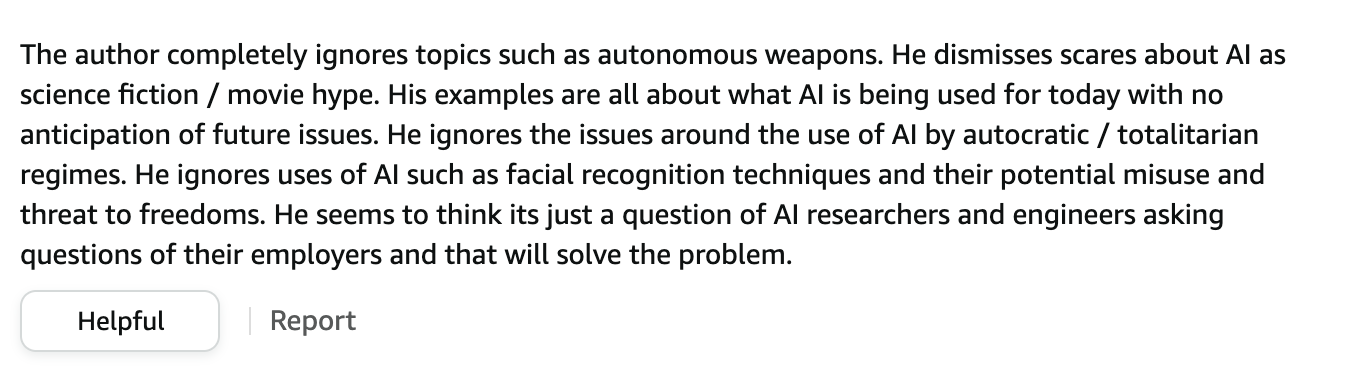
Since then, I’ve continued to work and consult in the AI space, and one thing has become very clear. The narratives around AI are still unfolding, and we still have so much work to do to understand it. Yes, I still do dismiss scares about AI, and with reason. I did leave out important topics like autonomous weapons and chose to report on misuses that are different from the typical headlines that everybody knows already.
While The Ethics of AI may have laid the foundations, it also asked questions that it could not yet conclude. What does it mean to be human in an age where machines aim to replicate our thought processes? And can they? What responsibilities do we bear to ensure the responsible creation and deployment of these tools? How can we become both the architects and guardians of a future where AI does not deepen existing inequalities but heals them? How do we build a future where technology isn’t about profitability but about creating a more equitable, compassionate world?
Through Honest AI, I’ll be exploring topics such as:
Cutting away the hype to understand what AI and ML can really do for people
Sharing real-life case studies on how companies are using this technology, covering the good, the bad, and the in-between
Reflecting on human nature and introducing morality into the discussion
Understanding the connections between technology, AI, economy, and the future of work
I believe that as it stands, AI poses a systemic risk to building more unjust societies. And yet, it also opens an opportunity to completely rethink our approach to work and economics.
Who is Honest AI for?
This newsletter is for data scientists, engineers, AI developers, executives, and policymakers. It will cover everything from how AI is asking us to more closely examine humanity and human conscience, reflect on what kinds of societies, lives and work systems we can and want to design, and offer a critical viewpoint on current AI apps and legislation.
An Honest Note to End On
To write Honest AI, I am combining my thoughts and notes with an assistant editor and a little AI (ChatGPT) to write, review and proof. English is not my first language, so trust me when I say – it’s in your best interest that I get some help! Thank you for your time and attention.
I hope you stick around.
Subscribe to Honest AI today.