
I Got a $6,000 Quote for a Simple Website.
Here's Why That's Good News.

Welcome to the Human Override. Twice a month (or less), I share reflections about AI and society, sometimes pointing at battle-tested strategies for leveraging AI without outsourcing your thinking, helpful tips, and ways to preserve humanity when everything turns synthetic. This issue is in a new format. Let me know if you like it, please.
New readers highlight: Deborah H, Leadership Coach | Hendra H, General Manager | Sanija N, AI Engineer | Stephen L, VP | Hilary C, Director | Liem G, Policymaker and +43 more amazing people.
Welcome!
It hits me when I’m in line at the post office, scrolling through my phone, caffeine from my morning coffee barely kicking in. My thumb freezes on a notification: another company just slashed thousands of jobs, offering the inexorable rise of AI as the main reason for a decision “we don’t take lightly”.
Suddenly, my heart rate stutters, stomach tightening, the familiar surge of uncertainty flooding in. I can’t shake this swirl of emotions every time I see another breathless headline about AI “devouring” jobs.
On the one hand, these headlines can feel like exaggerations. It feels like the public conversation leaps from optimism to apocalypse without much nuance. For example, last year, ESPN introduced an AI tool to generate sports recaps and automate basic news briefs. The rollout led to a real reduction in temporary writer contracts for that narrow coverage. An undeniable job impact, though far from replacing entire newsrooms. It’s this kind of selective automation that gets turned into sweeping claims about AI taking over everything, which misses the real complexity.
And the “thousands of jobs automated” stat? I roll my eyes... It’s not like someone just hits Ctrl+Tab and poof, factories of code roll themselves out.
But then I pause: if a fraction of that is even remotely true, what’s to stop my role from being next in line?
On the other hand, let’s be honest, the capability in today’s tools - Claude Code, Cowork, Lovable, Codex, the new Gemini… you name it - is nothing short of astonishing. I’m torn between mocking the doomsayers and admitting I’m occasionally awestruck.
I remember those agonising all-nighters spent chasing down a redundant function that mercilessly crashed the database sync. Though I’ve not been coding for work for a few years, I hear from my friends, software engineers, that AI swoops in now, sketches out a fix in seconds, and I’m left wondering if I’m allowed to feel relief or if that relief is a harbinger of my own obsolescence.
Sure, I love that we don’t have to toil over boilerplate or debug the same mistake for the tenth time. But sometimes I find myself nostalgically craving that low-level grind, that sense of victory when you at last crack a stubborn bug. There’s a strange guilt in watching AI handle the grunt work. I should be grateful, right? Yet I can’t help suspecting that by relaxing a bit, I’m edging closer to being replaced.
While all the chatter is about layoffs and cutbacks, I can also see startups and more innovative incumbents churning out more features, better customer service, sleeker products, and entering new markets. Some even create entirely new market categories (check out Synthesia). It makes me wonder if these AI breakthroughs are really unlocking growth, or just shifting costs around until someone, somewhere, gets axed. And perhaps it is this dichotomy that is wrong. It’s not an or-or. All those things can live together.
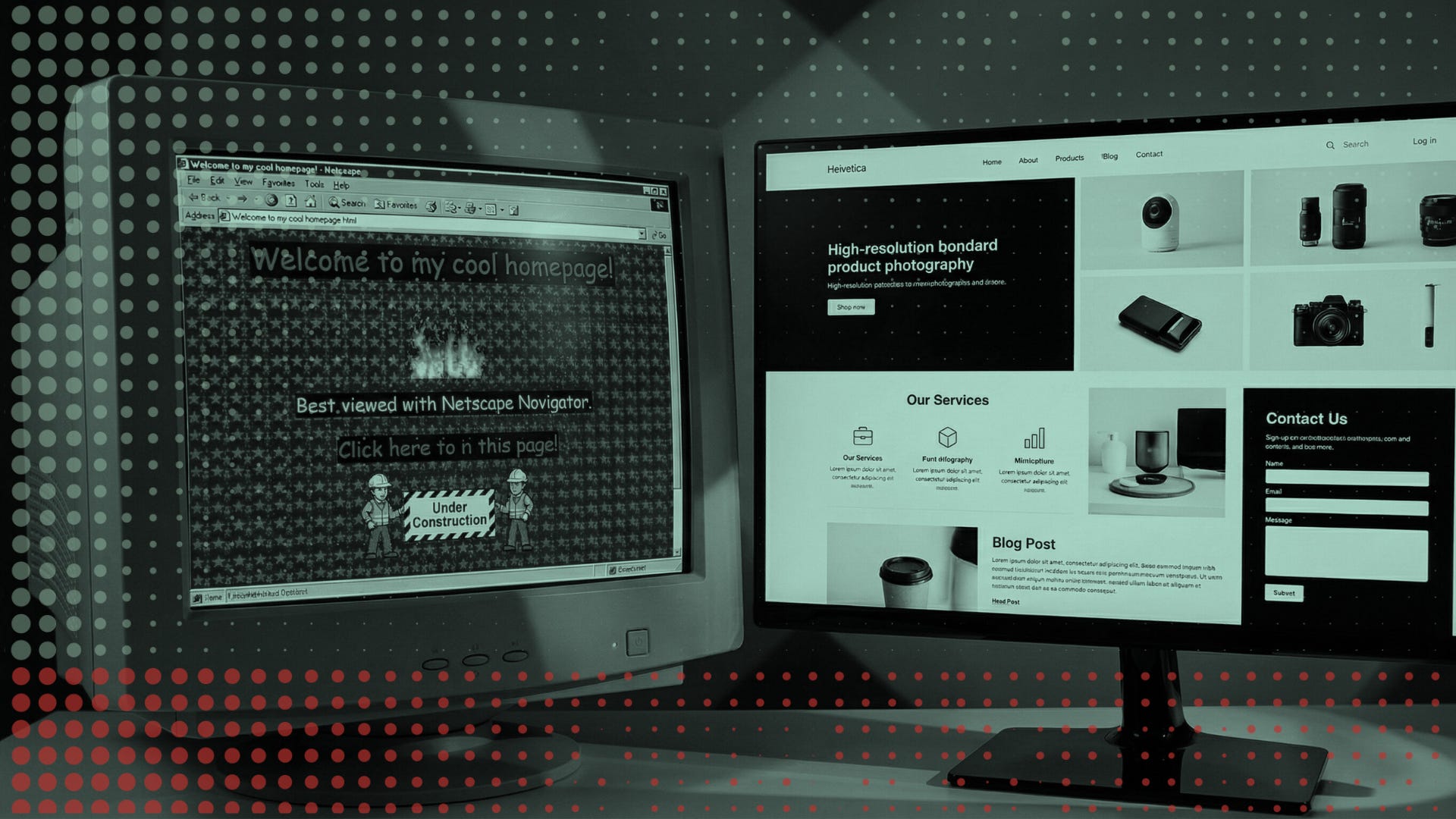
Let’s take web design as a case study, an interesting market that one would have thought was dead several times already.
In 2012, I spent $500 on a guy developing a simple, straightforward HTML wedding site, no frills. Now I’ve got a $6,000 quote for rebuilding my personal website. Insane? Maybe. But if I piece together vibe-coding credits, hosting fees, build hours and monthly tweaks, I’m looking at north of $10,000 over a few months if I choose to do it myself. So yes, while the sticker shock stings, I also get why the market bears it.
The web has morphed wildly: static HTML in ’95, CMS and blogs by ’05, mobile-friendly and analytics-driven by ’15, and now full-blown digital products optimised for performance, security, accessibility and conversions. That evolution didn’t hollow out jobs. Instead, it reshaped them and expanded the field. Mordor Intelligence pegs the web design market at $56 billion in 2024, with growth to $92 billion by 2030 (Mordor Intelligence, 2026)[1].
Site builders, WordPress, no-code platforms were supposed to kill off developers. Instead, they lifted the floor and raised the ceiling. AI feels like the next tide. It will crank out your boilerplate, draft your components, prune your routine hours and then clients will demand more: smarter, deeper, faster. They always do.
I can picture what this rising ceiling looks like. Imagine a client who wants a web experience that evolves in real time. The site greets each visitor by name, adjusts the layout and messaging based on browsing habits, and even morphs its look and tone for different audience segments as they interact. The AI analyses feedback, cross-references external events, and auto-launches fresh features to keep the user engaged. Suddenly, it is not enough to just deliver a site that loads fast; the bar keeps moving upward, and staying ahead means inventing experiences that were barely imaginable a year ago.
Still, I can’t avoid wondering: is this wave different? Or will history repeat? When factories electrified, manufacturing jobs doubled, output tripled, and employment climbed (U.S. Bureau of the Census, 1975)[2]. Can we trust that pattern again?
So here I stand, torn. Part of me wants to cling to old certainties; another part is itching to plunge into every new tool. I feel equal measures of dread and excitement, scepticism and hope. Maybe that’s exactly where we’re supposed to be: uncomfortably on edge, learning fast, and trusting that adaptability indeed has always been the core skill to hone.
I keep coming back to one idea: uncertainty and change are the only certainties, and curiosity is a solid strategy for being a protagonist. Letting curiosity lead means I can hold all this ambiguity without getting paralysed, letting myself explore instead of defend, and keep moving through the thrill and the fear. It’s a way to lead, not just react.
The total available market doesn’t shrink when capability expands. It grows.
Calm down. Learn the tools. Raise your prices.
That’s always been the playbook. Let’s hope it holds even now.
___
PS.
Webinar: I'm running a small, live session on the one question nobody's answering well: how do you decide what to learn when everything changes every quarter? I'll share the framework I've used to stay relevant across four career pivots and an AI revolution. 50 spots, so it stays conversational. 35 USD. Grab a seat here → The AI Mindset Shift
This article’s writing level: L1 - Human led. (What are these levels?)
Further reading: AI’s Wake-Up Call: New SHRM Research Reveals 23.2 Million American Jobs Already Impacted. 2025. A more nuanced study on what automation does to jobs.
Sources:
[1] Mordor Intelligence. (2026). Web design market size & share analysis – Growth trends & forecasts (2025–2030). https://www.mordorintelligence.com/industry-reports/web-design-market
[2] U.S. Bureau of the Census. (1975). Historical statistics of the United States, colonial times to 1970 (Bicentennial ed.). U.S. Government Printing Office.