
I Caught Myself Despising People Who Slept In
What a burnt-out year of five-a.m. mornings taught me about adapting for the AI era.

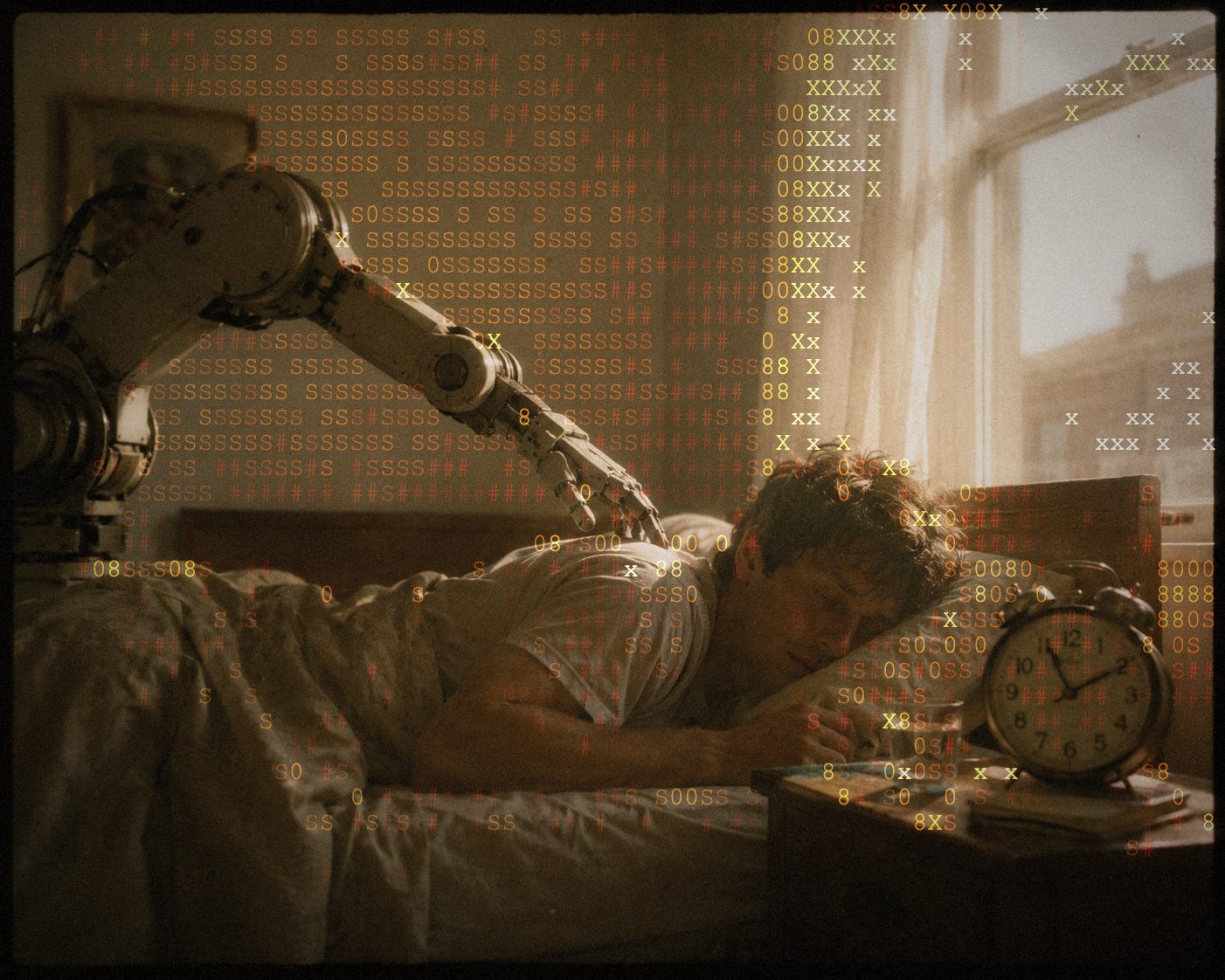
I hit rock bottom the morning I felt contempt for a colleague who slept in and couldn't make it to the office by 11.
I wondered how a man in his twenties, working in an unforgiving tech industry, could be so unoptimised. How dare you?
How had he not read The Miracle Morning, The 5 A.M. Club, Atomic Habits, every productivity-obsessed Twitter account I followed? How did he not know that a life is a system and a system can be tuned?
For about a year, I woke at 5am to become a better person. Pray 20 minutes, meditate 10, stare at the goal on my vision board for 10, 20 minutes learning something new, all before the rest of the house was conscious. I had joined the superhuman club.
It worked, in the sense that I was awake at 5am, got things done by noon, and eventually ticked off most of what was on that vision board. It failed at everything that mattered to my soul. I became a man who looked at his team, friends and family and privately felt superior to them.
The contempt reached my faith. I’m Catholic, and prayer had become another input in the optimisation toolset, something I did well, on schedule, to get a result, which is the opposite of what prayer is. You cannot optimise your way into being loved. Grace is, by definition, the thing you did not earn and cannot engineer, and I had built a life with no door it could walk through. My heart was closed for renovation, and nobody was coming through.
I tell you this now because the machine I strapped to my mornings a decade ago is nothing next to the one we’ve all strapped to our minds this year. AI is the most seductive optimisation tool ever built, and it promises to remove the last frictions a human life still runs on: the slow thought, the bad first draft, the waiting, the not-knowing, the needing of other people. This spring Pope Leo XIV published an encyclical touching on these topics, Magnifica Humanitas. Among the sea of shallow commentary online, I’ve finally found one that resonated deeply:

One particular paragraph inspired me to write this post:
“This is why Leo’s encyclical lands so differently for me than a generic warning about screen time or productivity culture. His deepest point is that technology can tempt us to despise the very things that reveal us as human: dependence, limitation, embodiment, need, relationship, and receptivity to grace.” [Emphasis mine].
One of the passages that I found most penetrating in Pope Leo’s document is the claim that we are being tempted to see ourselves as projects to be optimised rather than persons made for relationship. He put a name to the thing that had already half-eaten me ten years before the modern AI tools existed and became omnipresent.
Now let me make the case against myself, because it's strong and I've felt its pull for ten years.
I must admit, the routines worked. I hit the goals I visualised every morning for a year.
Ten years on, the companies got built, the career survived being torn up and rebuilt more times than I can count, I did well financially, and I cannot prove the five a.m. mornings didn’t help. Discipline can be love with its sleeves rolled up. And AI is a gift in many ways. It takes the drudgery that should never have made the desk of most knowledge workers and makes it vanish. The man who tells you to embrace your limitations is usually the man who has already cleared his; it’s easy to praise the slow road from the far end of it. There is something a little obscene about a founder who got everything he chased turning around to warn you off the chase. Limitation is not holy. Efficiency has fed more people than romance ever has.
All of that is true. And none of it is what pulled me out. Rationalising an argument, the logic and logistics are never enough. You need Grace.
What pulled me out was a two-and-a-half-year-old and my wife. I’d started the company when my first son was that age, and for two years my wife carried her PhD and our boy at the same time while I poured myself into the build. It was not an ordinary evening when a call reached me halfway through a hackathon — “enough, get your ass home” — and I left the laptop open on the table and jumped on an Uber. What I walked into stays between me and that house. I'll only say that no morning routine on earth would make me the husband and father that room needed, and that I never went back for the laptop (figuratively). Presence is not a system you can run despite all the self-optimisers telling you to “time box” the date night with your partner on the calendar.
Our daughter was born in the second year of the company, and between them, my wife and two kids imposed themselves on my life until the routine had to move over and make room. No book has ever managed to do that.
So, if the optimisation worked to achieve some goals, what was the problem?
There is a scarcity that tells the truth: I am limited, I cannot make it alone. That is the door grace comes through. But I couldn’t stand at the door and wait. I took a true limit and tried to engineer my way clean out of it, and I made the optimisation tools the god who would save me. But a man busy saving himself has no room left to be saved. He can only earn. He can never receive.
What the burnout and the marriage and those two small people broke open… What Grace broke open was the reverse: I am already enough. Already loved, before the goals and without them. Run the tools from there and they change on you. From abundance, you can pick up the most powerful machine ever made and it stays a machine, a servant. From scarcity, you pick up a pencil and it becomes a god you have to appease every morning at five. The thing is, abundance is already here. The tech messiahs promise you the forthcoming age of abundance, failing to see the abundance we already have. It’s the old marketing trick in the end — fake or create scarcity to sell more.
Most survival advice for the AI era comes in two flavors: resist the machine, or master it. I sell neither. The one question that ever decided anything for me is: what are you building from? Build from the fear that you’re not enough, and AI will only make you faster at fleeing yourself; you’ll arrive nowhere at a spectacular clip. Build from the plain fact that you’re already loved, and the same tool becomes what it was always for: leverage in the hands of someone who knows he is not a machine.
The encyclical has a name for where this points: a life of openness and communion. I’ll add only what a decade of getting it wrong taught me. My son loves fishing, and he often invites me to fish with him. I end up frustrated because I don’t catch any and takes forever. The man who woke at 5am would have counted it as time he could’ve shipped. That is not the tax on a fulfilled life. That is the good life. Guard it like the last thing the machine can’t reach, because it is.
You’re not behind because you were never a project to optimise.
Go be a person.
This piece really resonated and I especially loved the line: "AI is the most seductive optimisation tool ever built, and it promises to remove the last frictions a human life still runs on: the slow thought, the bad first draft, the waiting, the not-knowing, the needing of other people." I recently published a newsletter on grief-bots, and friction was central to my writing. Thank you for helping me to continue joining the dots in this ever-optimised world.