

Exploring AI and storytelling in our education system

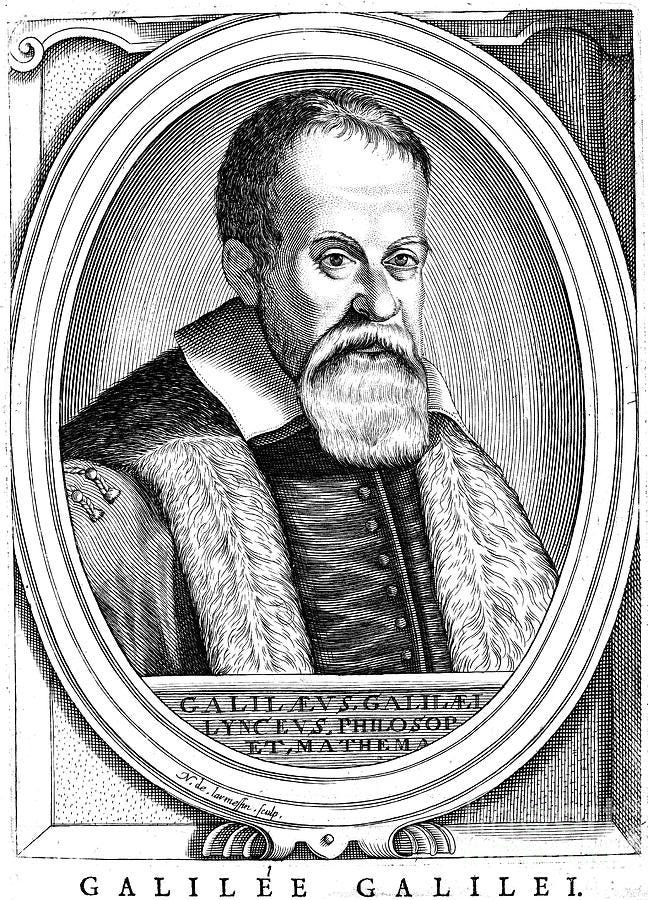
Image credits: Galileo Galilei (1564-1642) #14 is a photograph by Granger which was uploaded on July 3rd, 2012.
Twenty-two years ago, my math teacher, Mr. Mangolini, stood in front of my third-year class and lifted an old print from his desk. With its corners peeling from the frame, he explained that this was Galileo Galilei, an Italian mathematician, and showed his experiment on the inclined plane.
That day, we learned about the laws of gravity, the philosophy of science, and the debates around our understanding of the world, our place in the universe, and its creator.
Mr Mangolini’s classes have always stayed with me.
At first, he was a voluntarily distant teacher. His low, bass voice was musical in a way that contrasted with his formidable interrogations; in fact, he used to sing at the choir of my grandmother’s local parish.
Thanks to him, throughout my third year of school, my class’s grades became higher, our moral character strengthened, and we understood that in order to learn well, we had to persevere and think critically.
Mr Mangolini taught us not only math and physics but also the interconnection between math, history, science, literature, and philosophy.
We learned about the influences of his favorite mathematicians, from Cantor to Gauss and Viète. And when it came to what we wanted to do after school, he let his opinions be known. For instance, I still clearly remember his disappointment when one of his top students chose a professional diploma over university.
I’ve carried all of Mangolini’s lessons with me to this day – and I wonder how those lessons extend to the education system today.
“Education is an introduction to the totality of reality […]. A living hypothesis is in relationship with someone” — Luigi Giussani (The Risk of Education)
The Lessons of Online Learning
I thought of Mr Mangolini as I watched my son struggle in the education system during the pandemic.
When met with an iPad at home, my son struggled to pay attention during lessons; his confidence dropped, and he’d spend hours playing games or browsing the internet rather than focusing on the lesson in front of him.
My wife and I eventually decided to home-school him, and I could see how his confidence in learning and our relationship improved over time.
Even having the option to homeschool was a luxury. Not all children have access to laptops or iPads, and many parents cannot afford to take time off work. However, what this experience showed was that technology and education is perhaps one of the most important trade-offs to get right.
Indeed, a recent study by Yale showed that online interactions actually reduced neural signaling when compared to face-to-face conversations and reinforced the fact that human connection is what truly drives learning and personal growth.
Furthermore, vast amounts of evidence and scientific studies widely reported that increased social media use correlates with a higher risk for depression, as well as shortened attention spans.
This brings me to ask, how do we navigate the use of technology like artificial intelligence (AI) in education, both from the side of the teacher and the student?
Technology in education
Even Galileo Galilei, as a schoolboy as well as a teacher, would have used technology to some extent in the classroom.
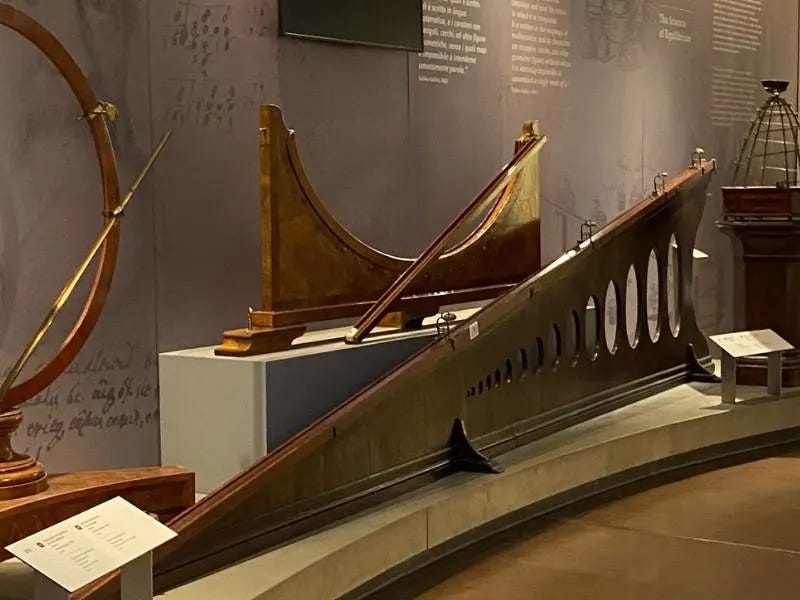
Image Credits: Galileo’s Inclined Plane Model / Back: Galileo’s Brachistochrone Model at the Galileum Museum in Florence – Photo by Uplifd.com
Yet, in the past twenty years, the rate of technological adoption has been unprecedented and remarkable, at least in most developed countries. It starks to me as an impressive difference between my class and my son’s; we were armed with only chalk and a blackboard vs. today's pervasive touchscreens in the classroom. A recent trip to Milan brought me driving by my old high school and made me realize how old and worn the building is. Some may even be horrified and point at that place as inappropriate for learning. But was it? Is it all about the fancy tools in the classroom, or what is education?
Just 15 years ago, IT was a new and often optional subject. We may have learned how to touch type or create websites on Dreamweaver, but very few would have learned how to write lines of code. Mr. Mangolini was one of the pioneers of teaching IT as a complementary subject, where he ran classes using Pascal (probably because of the sentimental value: my high school was named after the great scientist Blaise Pascal).
Today, products like Google, Wikipedia, and, most recently, ChatGPT have entered the conversation. And, what is perhaps even more interesting?
Unlike learning how to code or build websites, these products are incredibly easy to use and widely accessible, with very few barriers to entry. Students can quickly create an account and use ChatGPT to write an essay and even go so far as to prompt it with ‘Please include some errors’ to decrease the chances of being caught cheating.
When I spoke to teachers at a recent conference, they said that it was almost impossible to know whether these essays were automatically generated or actually written by the student.
Summary
Certainly, there’s a line to be drawn between and an equation to be balanced. And in my view, our students and children are going to use ChatGPT whether we like it or not.
What we can do is teach them how to constantly apply critical thinking. Show them how it reaches its end answer. Emphasize how we, as people, can use technology to improve and build upon our work without losing ourselves in it. There is so much that we can all give to our writing, teaching – even coding – that just can’t be replaced by a machine.
“You ask us [teachers] to be friendlier, softer, and kinder when giving out grades. But that’s when you stop learning. I treat you all like adults so that you can see what you can become. Learning is something that you can earn,” Mr. Mangolini once said to us.
I’d agree.
Inclined planes and laws of gravity may operate within strict parameters, but I think on some other level, so too do storytelling, and life lessons, and face-to-face conversations. The impacts of these are immeasurable, and I truly hope that for my son, and for our next generations, we can discern what is the place of technology (if any) to facilitate the immense task of educating a person as a whole.
In my next post, I’ll dive deeper into these questions and how we might design the future of education – what a utopian AI-enabled education might look like and practical steps that teachers could implement now to understand AI and guide students effectively.
—
If you haven’t already, get a copy of my book The Ethics of AI. I’d love to hear your feedback and start a conversation!