

Designing The Future of Work

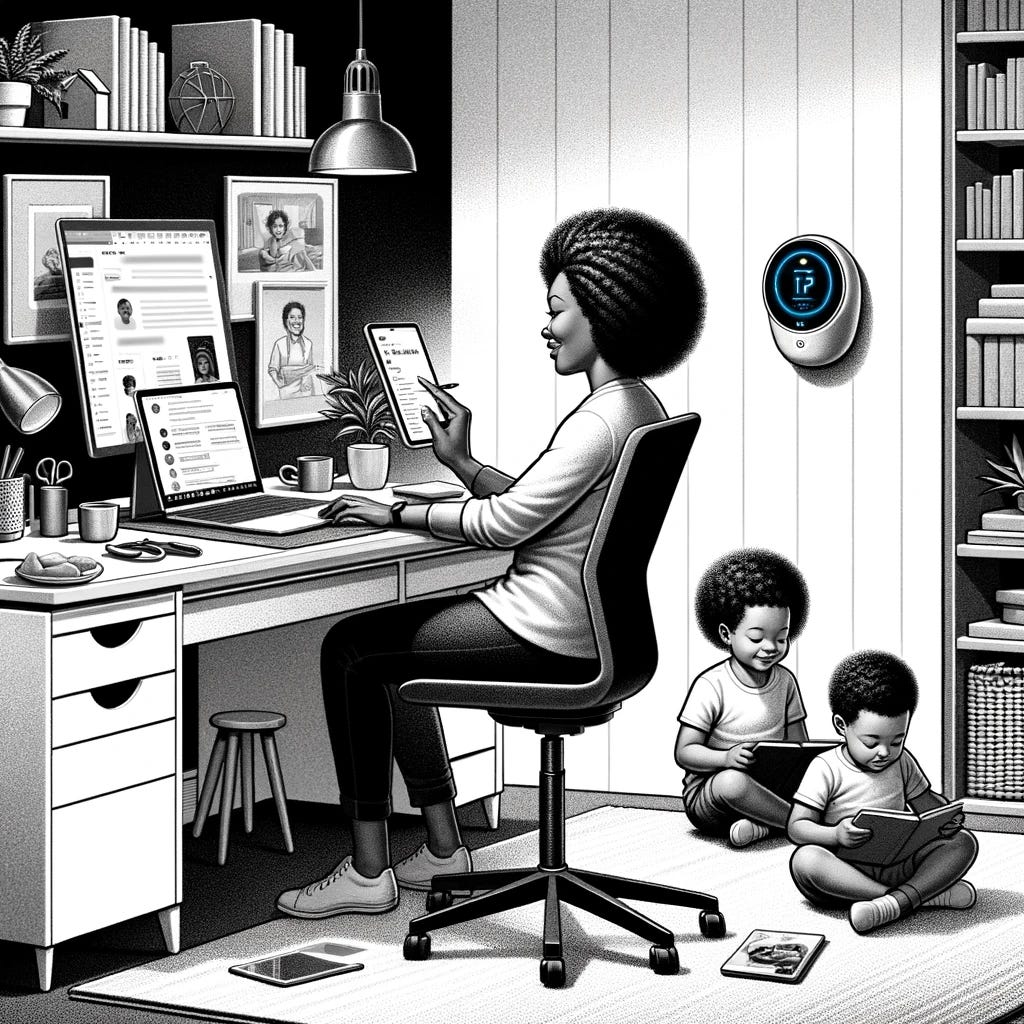
The age of automation asks a compelling question: How can technology not only revolutionize our work, but also reshape our societal norms and beliefs towards equity and fairness?
Read on for some thoughts on how we can use AI to balance workloads and create solutions to individual needs, redistributing wealth and ultimately, fostering a more equitable workplace.
For now, these are initial thoughts based on recent conversations and my personal experience with AI in the workplace. This topic is the guiding theme across all of my work and research; if you like it, please let me know in the comments what topic you’d like to see explored next!
Understanding equality vs. equity
Our societal systems, including the corporate world, have long debated the concepts of equality and equity.
While equality means equal pay for equal work, equity demands a more nuanced approach – recognizing and compensating for the individual’s unique circumstances and needs.
For instance, consider two employees with identical roles and responsibilities. One is a parent who needs to clock off early for the school run, but makes up for the lost hours late at night. The other does not have the same caring commitments, and can usually provide a more consistent output. Plus, they can almost always make the 5pm standup!
How can AI and flexible policies provide equitable solutions that recognise both situations and reward them equally?
And if you were asked to promote one over the other, who would you (honestly) choose?
Rethinking compensation models
The traditional model, equating long hours with productivity, is ripe for ethical disruption.
With AI enabling us to achieve more in less time (and send an automatic meeting transcriber on my behalf at the 5pm standup!), there is a compelling argument for rewarding efficiency over hours logged.
This shift not only modernizes our understanding of work but also offers employees the opportunity to build a fuller, more meaningful life around their working hours.
Strategies for an equitable workplace
To create a more equitable workplace, a multifaceted approach is needed. This involves individuals advocating for change, companies implementing new policies, and governments enacting fair legislation that eliminates historic pay differences and human bias.
I believe AI can really play a crucial role here, especially in reducing biases and promoting fairness. A business case exists for fair compensation: it drives happiness, productivity, and in turn, yields benefits like lower turnover rates, higher quality work, and increased resilience in the face of future systemic shocks or changes.
The influence of technology on society
While technology has the potential to enslave, as hinted at by thinkers like Umberto Galimberti and Machiavelli, it also holds the promise of liberation from outdated work models.
According to Italian philosopher Umberto Galimberti (coincidentally, also my great uncle), technology has become an end to an end, and man the means.
And for Machiavelli, the means justifies the end to technocracy where the means become the end itself. Therefore, technology enslaves; and from freedom to create and have power on nature, it is still poorly understood.
This is also innately connected to chasing infinite growth. In Laudato Si’ (LS), Pope Francis offered a brief resumé of the technocratic paradigm underlying the current climate and ecological crisis.
It is “a certain way of understanding human life and activity [that] has gone awry, to the serious detriment of the world around us” [LS, 13]. I’ve humbly found that this aligns with the thesis I sustain in my book about AI and ethics – the real problem is what understanding of human life and activity that the developers or AI currently have.
Deep down, it consists of thinking “as if reality, goodness, and truth automatically flow from technological power as such” [LS, 14]. As a logical consequence, it then becomes easy “to accept the idea of infinite or unlimited growth, which proves so attractive to economists, financiers, and experts in technology [LS, 15].
So, what are the solutions?
Right now, the current capitalist economy does not appear appropriately designed for supporting tech development. Because the only moral and ethical forces are growth, utility, and profit maximization, creation of wealth by the very few creates a miserable life for the rest of the majority — think of the various “gig” economies.
Among the proposed solutions are:
Universal income
4-day workweeks
Use of AI to minimize human bias in assessing productivity.
These innovations, far from reducing job opportunities, are argued to lead to more employment, equitable pay, and increased overall output. However, they have their practical problems too.
How I use AI for productivity
So what does life look like with more automation and more time?
In my last post, I touched on my own journey with AI and how it transformed my old life as an actuary in London.
Until recently, I was managing multiple ventures, working in a startup, investment consulting, and postdoctoral research. Yet, I always felt split too thinly across all of them.
An experience executive coach told me not to worry – most work is like that. 5-10% of our work is our highest quality, and the rest is usually average. And I feel like the reason that I have more time is because many problems that once took an entire of week coding can now be solved in a few hours with the help of ChatGPT.
So far, I’ve been using automation to save time on:
Small things: Quick projects, research, pet projects, some communication. Estimated time saved: 3 hours vs. 20 hours. A 7x improvement.
Long-term projects: For this, I’ve found the application of AI harder. Across my PhD thesis writing and supporting a growing startup with Data Science and Finance, I’ve often used AI to chase quick wins rather than support long-term planning and delivery. Estimated time saved: Difficult to say. I’d estimate this to be a 1.5x improvement.
If we have thirty productive working hours in a week, with ten left over for chitchat, lunches, and task transitions; and we have, let’s say, 15 hours on long-term projects, and fifteen on quick wins, we could reduce a 40-hour work week to 22-25 hours of focused work. That is almost a week reduced in half, with the same level of impact.
While these calculations are fairly generic, the principles can be applied to many high-paying jobs in financial services, strategic consulting, and technology.
This innovation, rather than reducing jobs, could employ double the number of people, double the output, and even pay work for about 10% less than before and such professionals would still have a very sweet life.
The results? Happier people, with more time for more meaningful projects, still well paid, while the company double the output saving on cost.
Summary
It would be a good idea to run a study across industries, and explore how this model of automation could benefit every class of society – or compensate for the automation of traditionally highly paid white-collar jobs with increased benefits for professionals that require hands-on work: nurses, cleaners, chefs, and drivers, to name just a few.
And imagine what society could do with that freed up time. Volunteer, rest, cook good, healthy food, spend more time with family and friends, write, make art, spend time in nature.
I know so many people that would create companies and more opportunities, and be able to redistribute that wealth, if they had one or two days a week to explore a side gig. Yet, they are currently stuck in the world of measuring and paying for work by time rather than by output.
What would you do with a couple of days a week?
And how are you using AI and automation in your workplace? This discussion is not just about reimagining work. It’s about reshaping our society for the better.
—
P.S. - My book, “The Ethics of AI: Facts, Fictions, and Forecasts”, explores such topics in more detail, with a focus on the future that we are building with a view to what we could be.
Why should you order a copy?
Unlock insights: Dig deeper into AI ethics and uncover practical perspectives that could strengthen your understanding of technology and its impact.
Join the conversation: I'm eager to hear your thoughts on which parts of the book resonated with you, and what topics you’d like to explore further.
Global access: Available on Amazon worldwide. Just click here for the US/Kindle versions.
Your support is invaluable.